.webp)
OpenAI Launches Jalapeño: Its First Custom AI Inference Chip
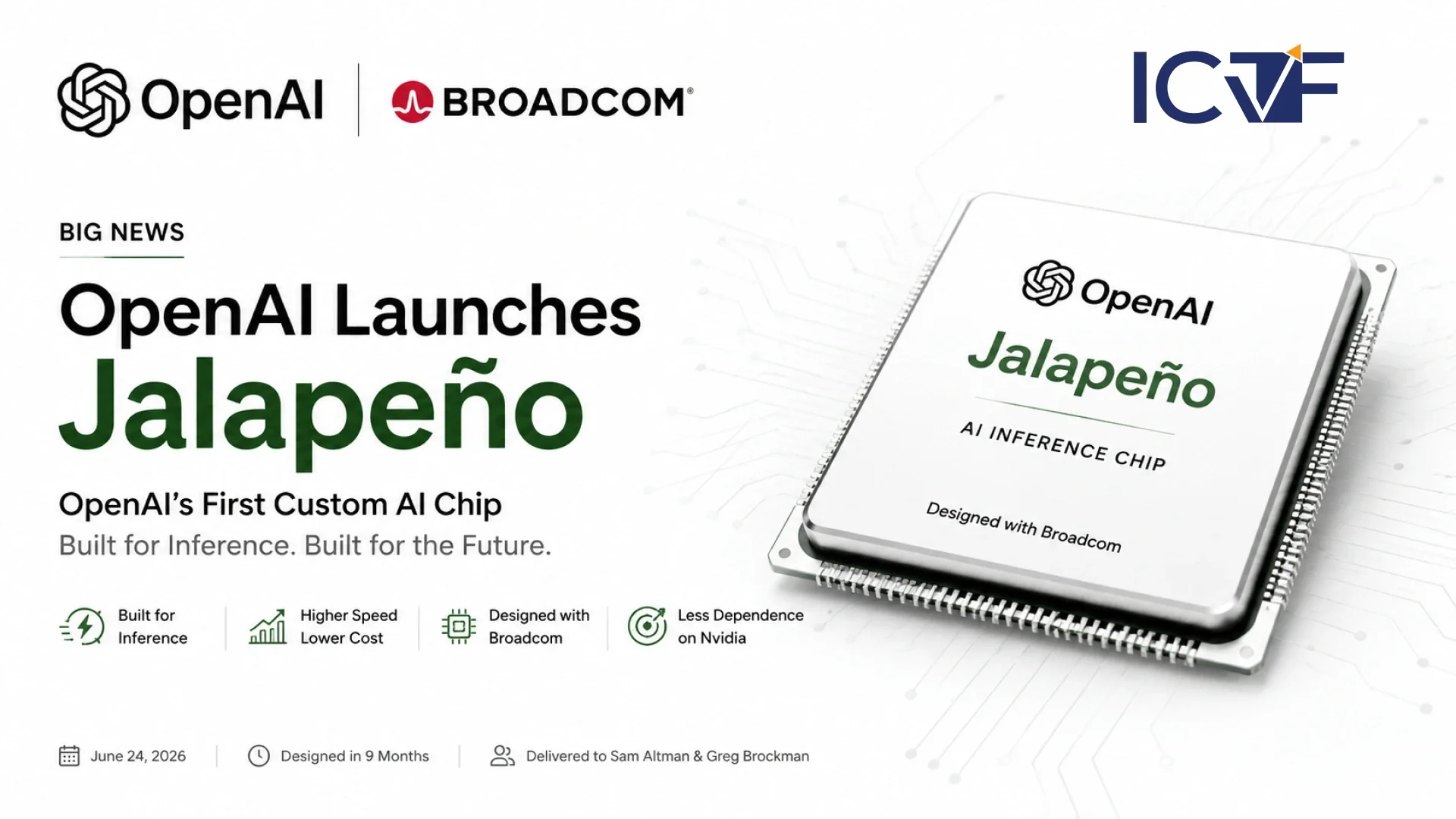
OpenAI has officially introduced Jalapeño, its first custom-designed AI inference chip, developed in collaboration with Broadcom. This announcement marks a major milestone in OpenAI's long-term vision of building a complete AI ecosystem that includes not only advanced language models like ChatGPT but also the specialized hardware required to power them. By designing its own AI chip, OpenAI aims to optimize performance, reduce infrastructure costs, and gain greater control over its computing resources.
Unlike traditional GPUs that are designed for both AI training and inference, Jalapeño has been built specifically for AI inference. Inference is the process of generating responses after an AI model has already been trained. Every time a user interacts with ChatGPT, inference takes place. Since billions of inference requests are processed daily, creating dedicated hardware for this task can significantly improve response speed while reducing energy consumption and operational costs.
One of the most remarkable aspects of the Jalapeño project is its development timeline. OpenAI and Broadcom reportedly completed the chip in just nine months, an exceptionally fast achievement in the semiconductor industry, where custom chip development often takes several years. This rapid progress demonstrates how quickly AI hardware innovation is advancing to meet the increasing demand for powerful computing infrastructure.
The partnership with Broadcom played a crucial role in bringing Jalapeño to life. Broadcom is one of the world's leading semiconductor companies with extensive expertise in designing high-performance networking and AI chips. By combining OpenAI's deep understanding of artificial intelligence with Broadcom's hardware engineering capabilities, the two organizations have created a processor specifically optimized for large language models and AI applications.
A key objective behind Jalapeño is to reduce OpenAI's reliance on Nvidia GPUs, which currently dominate the AI hardware market. Although Nvidia remains the industry leader for AI computing, demand for its GPUs has grown dramatically over the past few years, making them increasingly expensive and difficult to obtain. Developing a custom inference chip allows OpenAI to lower compute costs, improve hardware efficiency, and create a more scalable infrastructure for future AI services.
Jalapeño is expected to deliver several advantages, including faster response times, lower latency, improved energy efficiency, reduced operational costs, and better scalability for AI data centers. These improvements will benefit millions of users who rely on ChatGPT and other OpenAI services every day while enabling OpenAI to support increasingly powerful AI models in the future.
The introduction of Jalapeño also signals the beginning of a new era in AI hardware competition. Major technology companies such as Google, Amazon, Microsoft, and Meta have already invested heavily in designing custom AI chips to optimize their cloud infrastructure. OpenAI's entry into this space highlights the growing importance of specialized AI processors and suggests that the future of artificial intelligence will depend not only on better software but also on purpose-built hardware designed specifically for machine learning workloads.
Overall, the launch of Jalapeño represents a significant step forward for OpenAI and the AI industry as a whole. By investing in custom silicon, OpenAI is strengthening its technological independence, improving the efficiency of its AI systems, and preparing for the next generation of intelligent applications. As AI adoption continues to accelerate worldwide, dedicated inference chips like Jalapeño are expected to become an essential part of the infrastructure powering tomorrow's AI-powered products and services.