.webp)
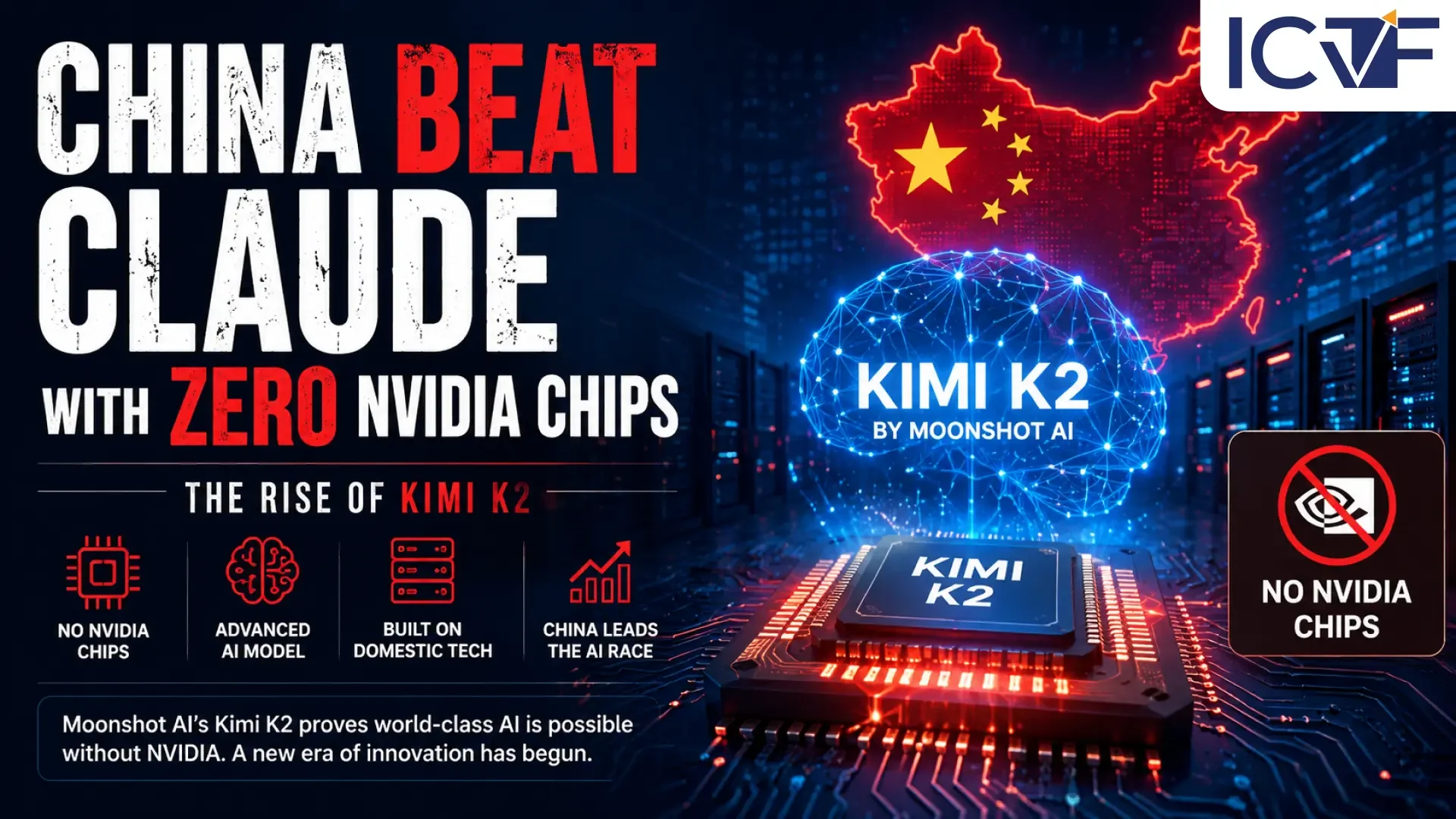
China Beat Claude with ZERO NVIDIA Chips? The Rise of Kimi K2
The global AI race has entered a fascinating new chapter.
For years, NVIDIA GPUs have been considered essential for training powerful large language models (LLMs). Companies like OpenAI, Anthropic, Google, and Meta rely heavily on NVIDIA's cutting-edge AI hardware.
But China's latest AI model, Kimi K2, is challenging that assumption.
According to recent reports, Moonshot AI developed Kimi K2 using domestic AI hardware instead of NVIDIA's latest GPUs, demonstrating that world-class AI may no longer depend entirely on American semiconductor technology.
Why This Matters
NVIDIA has dominated the AI hardware industry for years.
However, export restrictions have limited China's access to advanced NVIDIA chips.
Instead of slowing down, Chinese AI companies invested heavily in:
Domestic AI accelerators
Optimized distributed training
Efficient model architectures
Smarter software optimization
The result?
An AI model that is competing with leading systems like Claude, GPT, and Gemini.
What is Kimi K2?
Kimi K2 is the newest large language model from Moonshot AI, one of China's fastest-growing AI startups.
The model is designed for:
Advanced reasoning
Coding assistance
Mathematical problem solving
Long-context conversations
Multilingual understanding
Early benchmarks suggest it performs impressively against several leading open and commercial AI models.
How Did China Do It Without NVIDIA?
Rather than relying on NVIDIA's latest hardware, engineers focused on efficiency.
Their strategy included:
Training across large domestic GPU clusters
Advanced software optimization
Improved parallel computing
Better resource scheduling
Model architecture improvements
This demonstrates that software innovation can sometimes compensate for hardware limitations.
Does This Mean NVIDIA Is No Longer Important?
Not at all.
NVIDIA remains the global leader in AI hardware.
However, Kimi K2 proves that the AI ecosystem is becoming more competitive.
Instead of one dominant hardware supplier, we may see:
More regional AI chip manufacturers
Greater software optimization
Lower AI infrastructure costs
Increased innovation worldwide
Competition generally benefits developers, businesses, and end users.
What This Means for Developers
For AI developers, this is exciting news.
Future AI breakthroughs may come from:
Better algorithms
Efficient training methods
Open-source collaboration
Alternative AI hardware
Smarter infrastructure
Innovation is no longer limited to companies with access to the most expensive GPUs.
Final Thoughts
The AI race is no longer just about who owns the most NVIDIA GPUs.
It's increasingly about who can build smarter systems, optimize training pipelines, and innovate under constraints.
Whether Kimi K2 ultimately surpasses Claude or not, it has already demonstrated something significant:
The future of AI will be driven not only by hardware, but by creativity, engineering, and efficiency.