.webp)
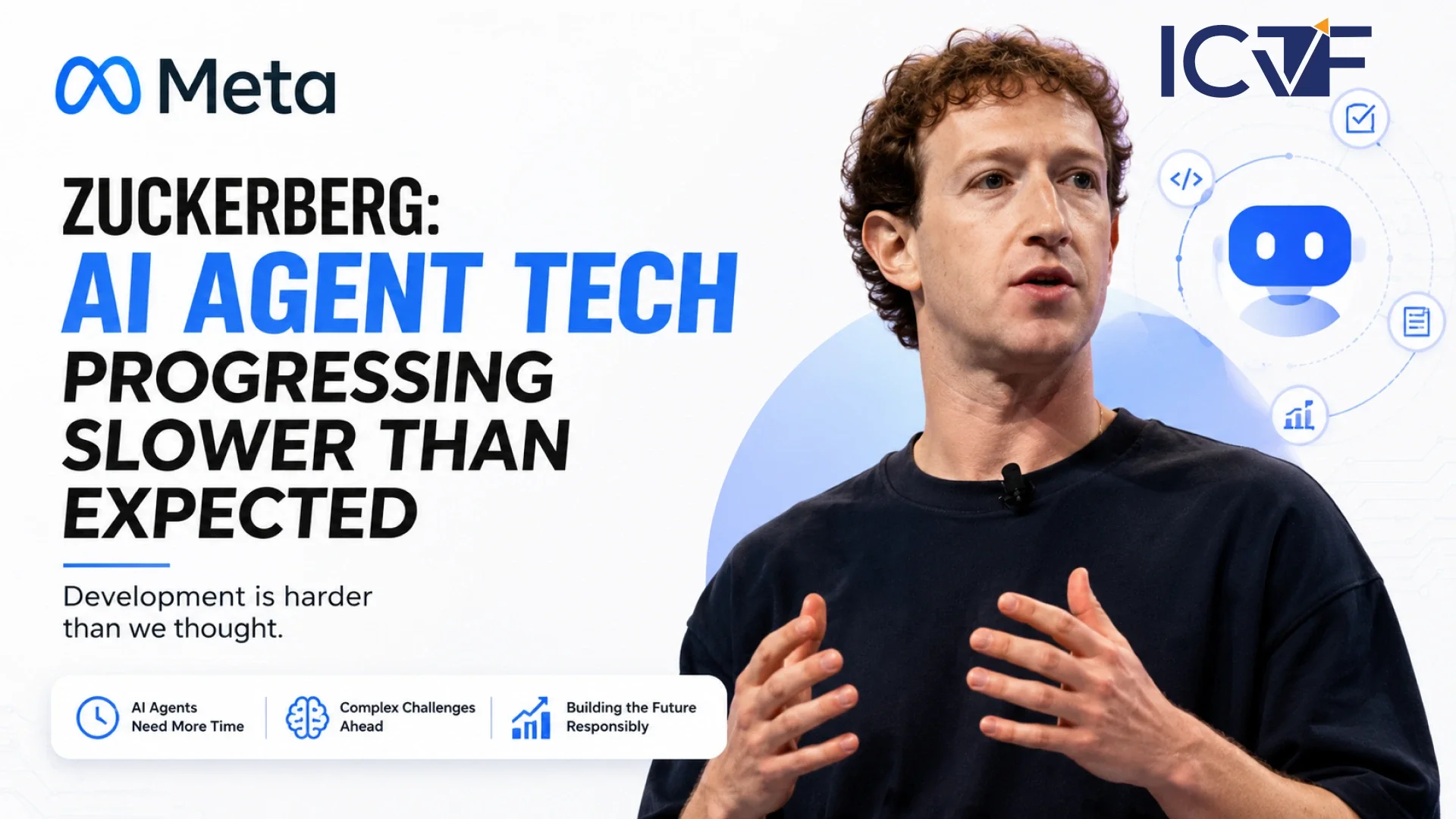
Meta's Zuckerberg Says AI Agent Technology Is Progressing Slower Than Expected
Artificial intelligence has become one of the fastest-growing technologies in recent years, with companies racing to build smarter AI assistants and autonomous AI agents. However, Meta CEO Mark Zuckerberg recently acknowledged that AI agent technology is developing more slowly than many people originally anticipated. His comments highlight the significant technical challenges that still need to be solved before AI agents can reliably perform complex real-world tasks.
AI agents are designed to go beyond simple chatbots. Instead of only answering questions, they can understand goals, make decisions, complete multi-step tasks, interact with software, and automate everyday workflows. Major technology companies including Meta, OpenAI, Google, Microsoft, and Anthropic are investing billions of dollars into AI agent research because many experts believe these systems will become the next major evolution of artificial intelligence.
According to Zuckerberg, today's AI models are already highly capable at reasoning, coding, content creation, and answering questions. However, transforming these capabilities into reliable autonomous agents remains a much more difficult challenge. AI agents must understand context, remember long-term information, make accurate decisions, recover from mistakes, and safely interact with digital tools without constant human supervision.
One of the biggest obstacles is reliability. While current AI models can perform many individual tasks exceptionally well, they may still struggle when completing long sequences of actions independently. Small errors during one step can affect the entire workflow, making it difficult for AI agents to consistently achieve the desired outcome. Researchers are actively working on improving planning, reasoning, memory, and decision-making capabilities to address these limitations.
Meta continues to invest heavily in AI infrastructure despite these challenges. The company has expanded development of its Llama family of open AI models, increased spending on AI data centers, and introduced Meta AI across Facebook, Instagram, WhatsApp, and Messenger. These investments demonstrate Meta's long-term commitment to making AI assistants more capable and accessible to billions of users worldwide.
The competition in AI remains intense. Companies such as OpenAI, Google, Microsoft, Anthropic, Amazon, and xAI are all developing increasingly advanced AI agents that can write code, conduct research, analyze documents, browse the web, and automate complex workflows. Although progress has been remarkable, Zuckerberg's comments serve as a reminder that building truly autonomous AI requires solving many difficult engineering and safety challenges.
Industry experts believe AI agents will continue improving rapidly over the next few years. Future systems are expected to become more reliable, capable of handling longer tasks, collaborating with humans more effectively, and integrating seamlessly into everyday software. As research advances, AI agents may eventually become essential digital assistants for businesses, developers, students, and consumers.
Overall, Zuckerberg's statement reflects a realistic perspective on the current state of AI. While artificial intelligence has made extraordinary progress, creating dependable AI agents that can operate independently in real-world environments remains a complex problem. Continued investment, research, and innovation will be necessary before AI agents reach their full potential and become a routine part of daily life.