.webp)
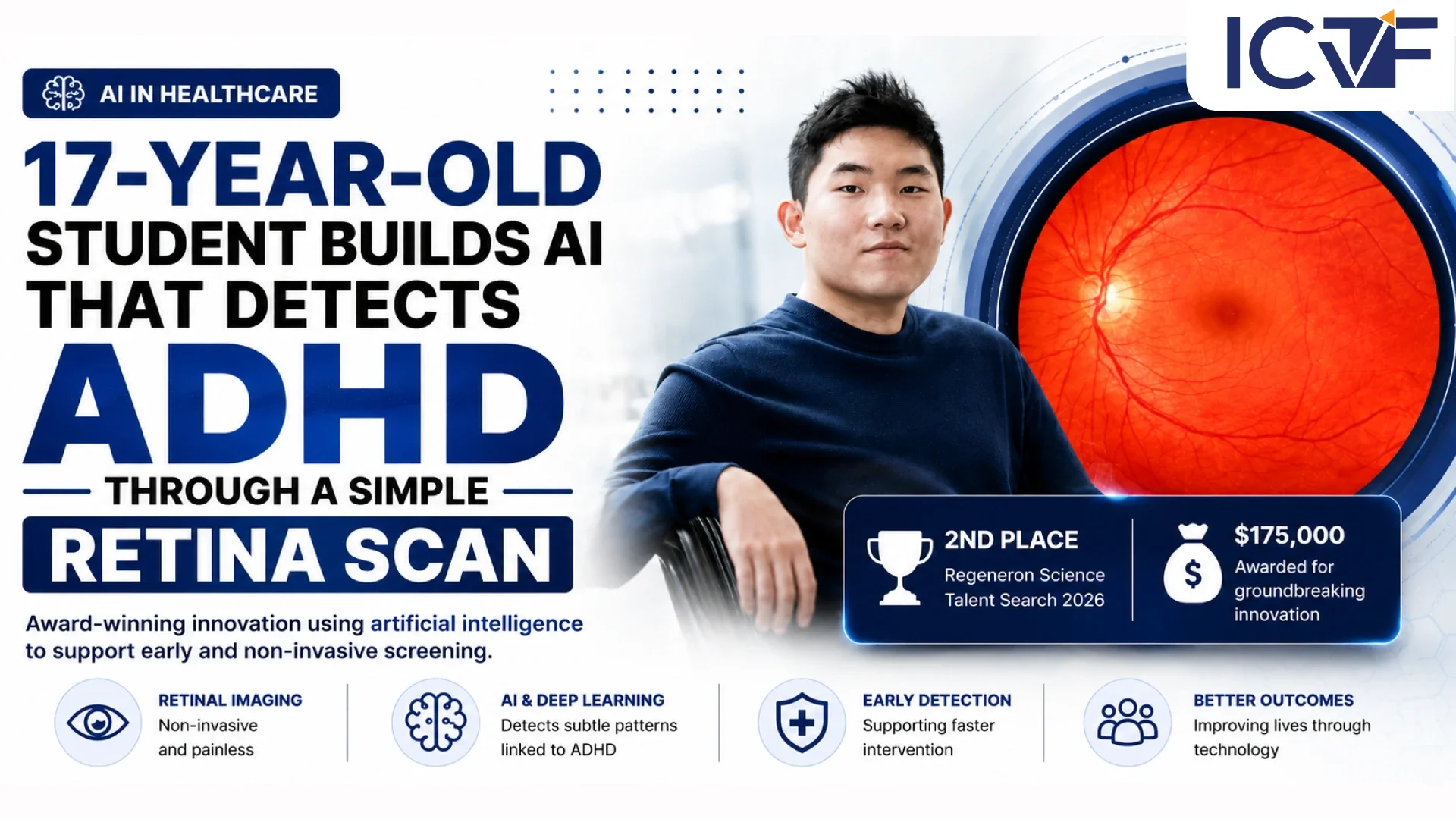
17-Year-Old Student Builds AI That Detects ADHD Through a Simple Retina Scan
Artificial Intelligence continues to reshape the future of healthcare, and one remarkable innovation is proving that age is no barrier to groundbreaking discoveries.
A 17-year-old student from New Jersey has developed an experimental AI system capable of identifying Attention Deficit Hyperactivity Disorder (ADHD) by analyzing retinal images. The project has already received international recognition and demonstrates the growing role of AI in medical diagnosis.
What Is the Project?
The student developed an AI-powered screening system called RetinaMind, designed to analyze photographs of the retina—the light-sensitive tissue located at the back of the eye.
Rather than relying solely on behavioral assessments and lengthy clinical evaluations, the system examines tiny patterns within retinal images that may be associated with neurodevelopmental conditions.
Using advanced computer vision and deep learning techniques, the AI identifies subtle visual characteristics that may indicate ADHD.
Why the Retina?
Researchers have increasingly discovered connections between the human retina and the brain because both develop from the same neural tissue during early development.
Since the retina shares many neurological characteristics with the brain, changes in retinal structures may provide valuable information about certain neurological and developmental disorders.
This makes retinal imaging a promising, non-invasive diagnostic tool.
How Does the AI Work?
The system follows several key steps:
High-quality retinal images are captured.
Images are preprocessed to improve quality.
Deep learning models analyze blood vessels, optic nerve structures, and other microscopic retinal patterns.
The AI compares detected features against trained medical datasets.
A prediction is generated indicating the likelihood of ADHD.
Although still experimental, the technology demonstrates impressive potential for supporting medical professionals.
Recognition and Award
The innovative project earned second place at the 2026 Regeneron Science Talent Search, one of the United States' most prestigious science competitions for young researchers.
Along with national recognition, the student received a $175,000 prize, highlighting the significance of the research and its potential impact on future healthcare.
Why This Innovation Matters
Current ADHD diagnosis often involves:
Multiple behavioral evaluations
Interviews with parents and teachers
Psychological assessments
Clinical observations
Long waiting periods
An AI-assisted retinal screening system could significantly improve this process by providing:
Faster screening
Non-invasive testing
Lower healthcare costs
Earlier intervention
Additional decision support for doctors
It is important to note that such AI systems are intended to assist healthcare professionals rather than replace clinical diagnosis.
Potential Applications
If validated through larger clinical studies, technologies like RetinaMind could eventually be used for:
Early ADHD screening
Pediatric healthcare
School health programs
Neurological research
Mental health support
Large-scale health screening initiatives
This could be especially valuable in regions with limited access to specialist healthcare services.
Challenges Ahead
Despite its promise, the system remains in the research phase.
Before becoming part of routine medical practice, it must undergo:
Extensive clinical validation
Regulatory approval
Diverse population testing
Independent scientific review
Long-term accuracy evaluation
Ensuring fairness, reliability, and patient privacy will also be critical before widespread adoption.
The Growing Role of AI in Healthcare
Healthcare is becoming one of the fastest-growing sectors for Artificial Intelligence.
AI technologies are already being used to:
Detect diabetic retinopathy
Identify cancer in medical images
Predict heart disease
Analyze MRI and CT scans
Assist radiologists
Personalize treatment recommendations
The RetinaMind project demonstrates how young innovators are contributing to this rapidly evolving field.
Final Thoughts
The story of a 17-year-old developing an AI system capable of detecting ADHD through retinal imaging is both inspiring and encouraging.
While RetinaMind is still under development, it showcases how artificial intelligence and computer vision can contribute to earlier, faster, and more accessible healthcare in the future.
Innovations like this remind us that the next breakthrough in medicine may come not only from established researchers but also from talented young minds driven by curiosity and innovation.